Your AWS SES reputation, protected.
Real-time monitoring, smart alerting, and deliverability insights for Amazon SES. Know when your bounce rate is climbing before AWS suspends your account.
Bounce rate (24h)
AWS limit: 5.0%
Complaint rate (24h)
AWS limit: 0.1%
Delivery rate (24h)
45,231 emails sent
Volume spike detected on [email protected]
3.2x above baseline · 2 minutes ago · routed to Slack
Sent
45,231
Delivered
44,689
Opened
18,276
Clicked
3,891
Amazon SES
Event ingestion and suppression sync
Slack
Alert notifications
Discord
Alert notifications
Alerts and digest reports
Webhooks
Custom HTTP endpoints
Apprise
Unified notification service
The gap
VDM shows you dashboards. It doesn't protect you.
AWS Virtual Deliverability Manager gives you metrics and recommendations, but has no alerting, no suppression management, and charges per email. When your bounce rate spikes at 2am, VDM won't ping your team.
No built-in alerting
VDM shows dashboards, but has zero alerting. You need to wire CloudWatch alarms, SNS topics, and Lambda functions yourself just to get a Slack message when your bounce rate spikes.
VDM costs add up fast
VDM starts at $0.07 per 1,000 emails on top of base SES pricing (with volume discounts at higher tiers). For most teams, that per-email surcharge adds up to more than a flat monitoring subscription.
Suppression lists are manual
SES gives you a basic suppression API, but no UI for searching, temporary expiry, notes, or bidirectional sync. Every team ends up building the same internal tooling.
Monitoring without action
VDM shows rates by ISP and sending identity, but no deliverability funnels, no sending heatmaps, no aggregate bounce reason analysis, and no anomaly detection. You see the data, but nothing acts on it for you.
See it in action
The whole product, not a teaser.
Every screen below is a real capture from the running app, seeded with realistic SES sending activity. Flip between the tabs to see what you actually get.
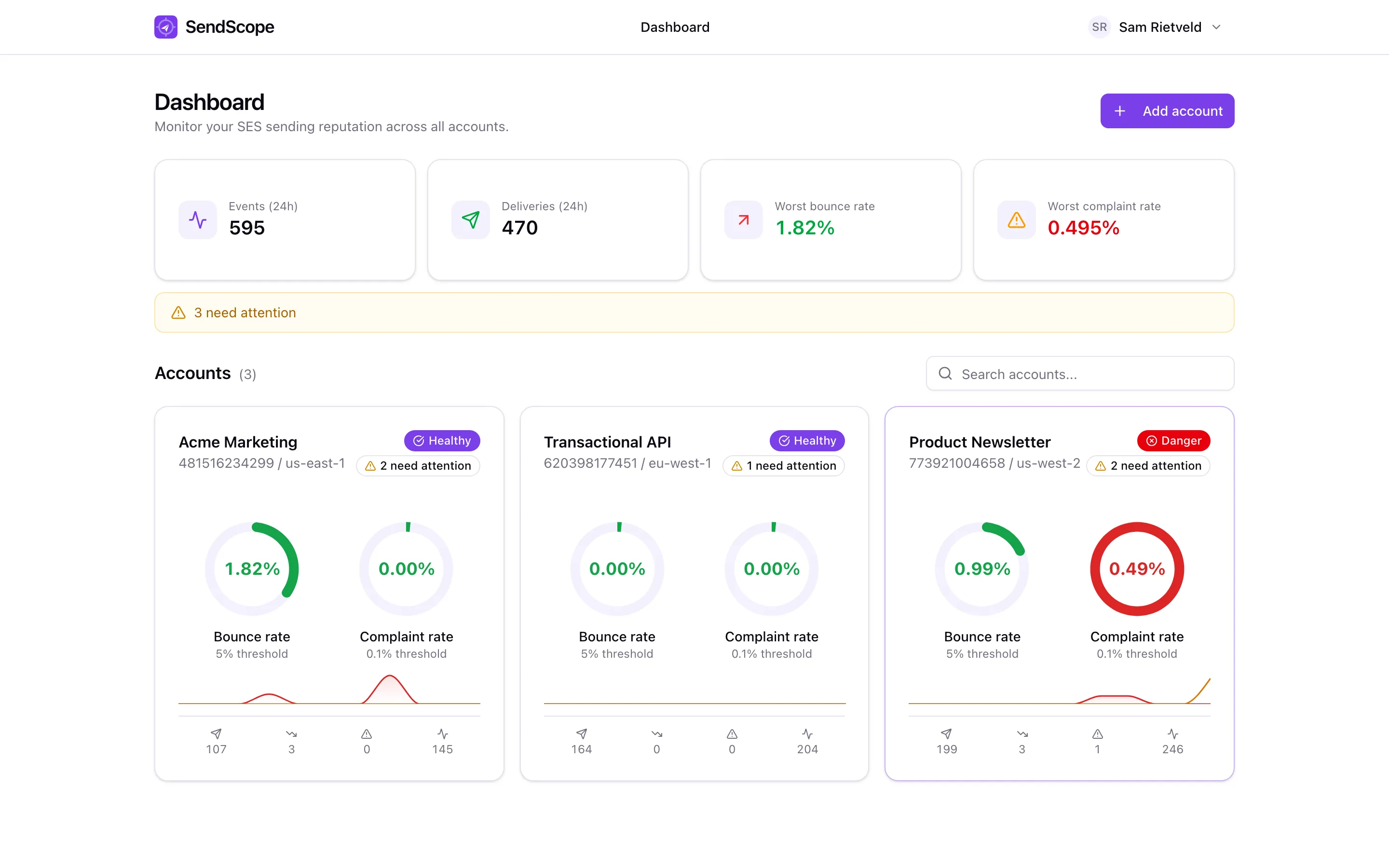
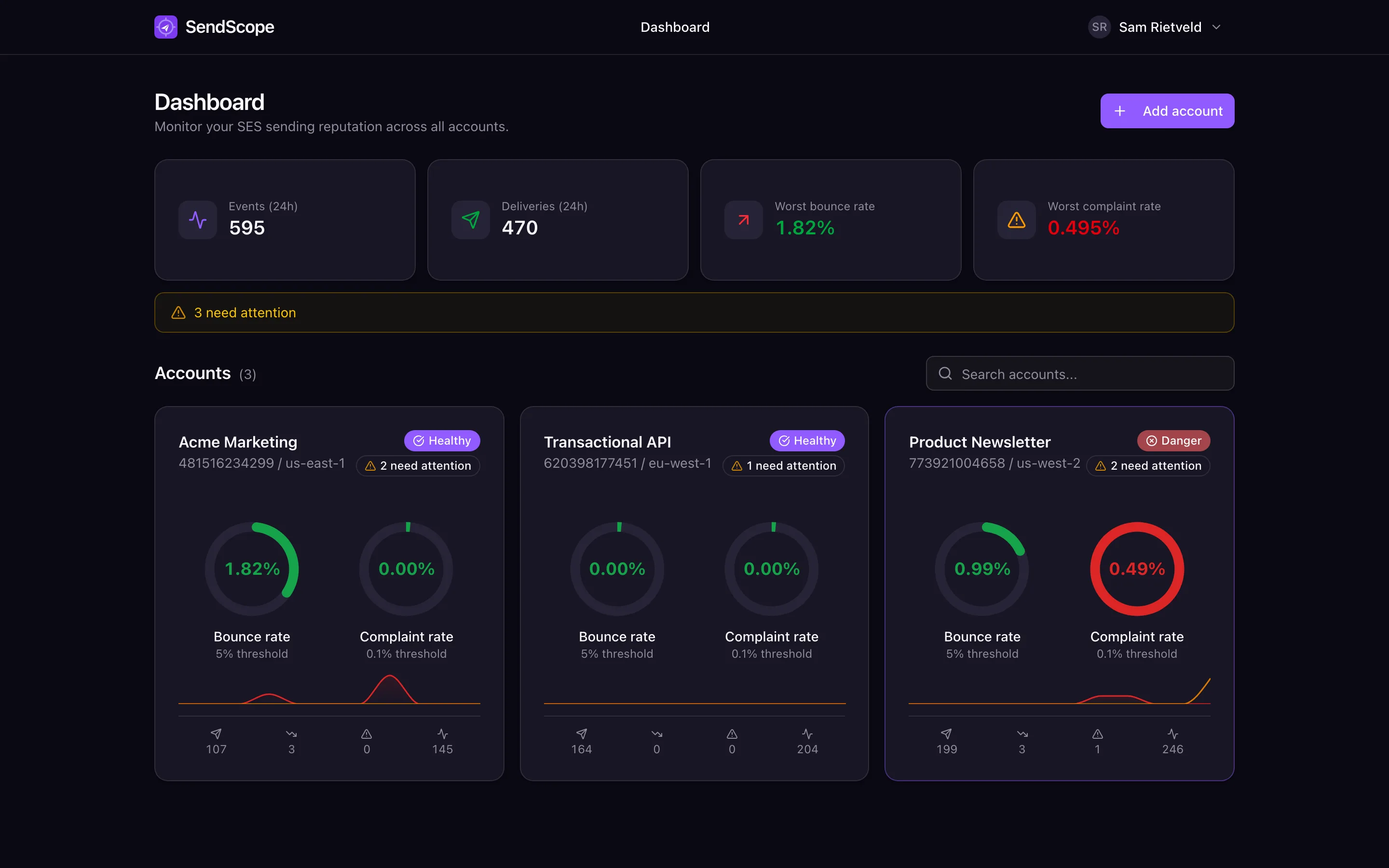
Every connected SES account at a glance: live bounce and complaint gauges, 24h volume, and a health badge per account so a sour reputation surfaces long before AWS puts you on probation.
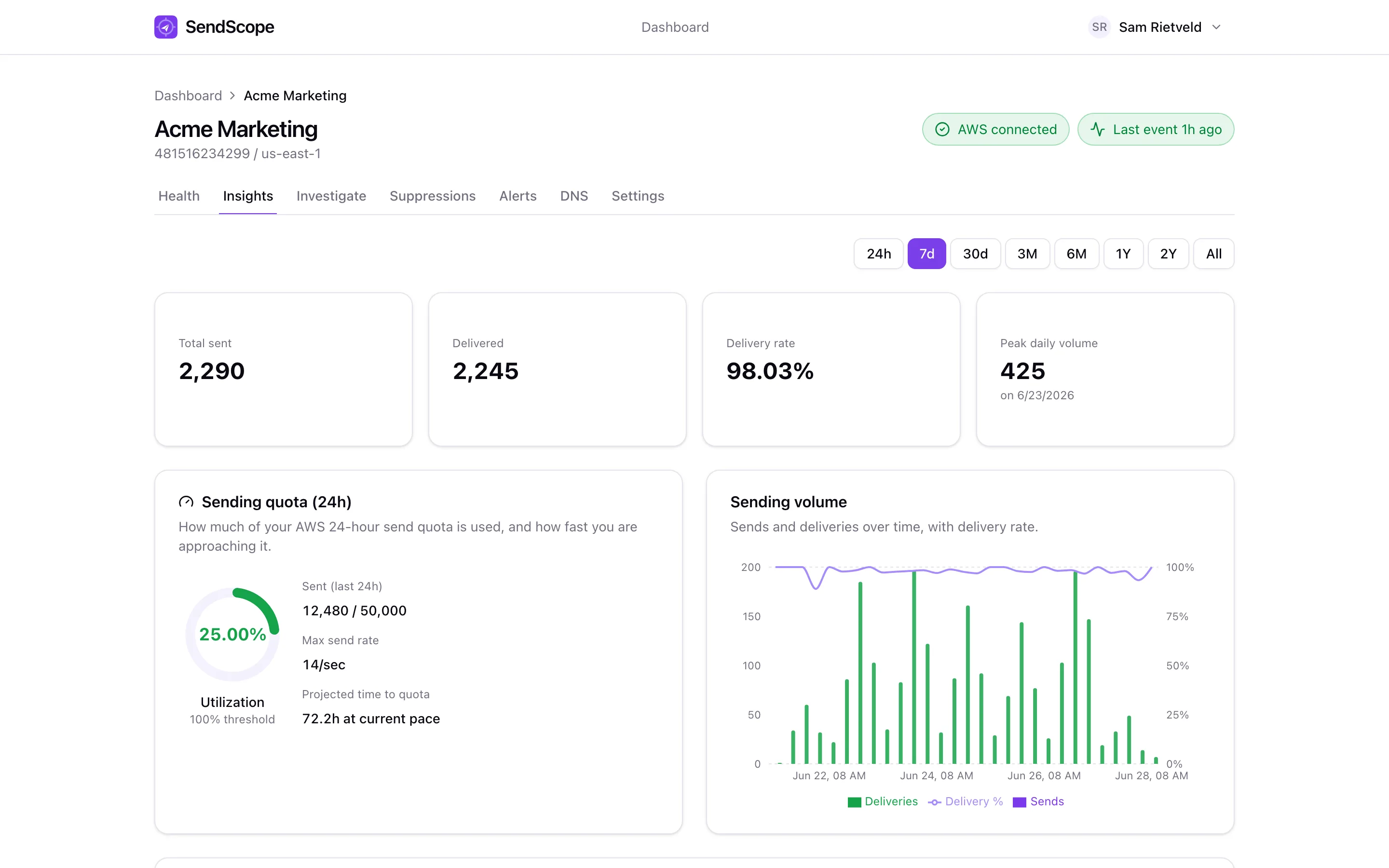
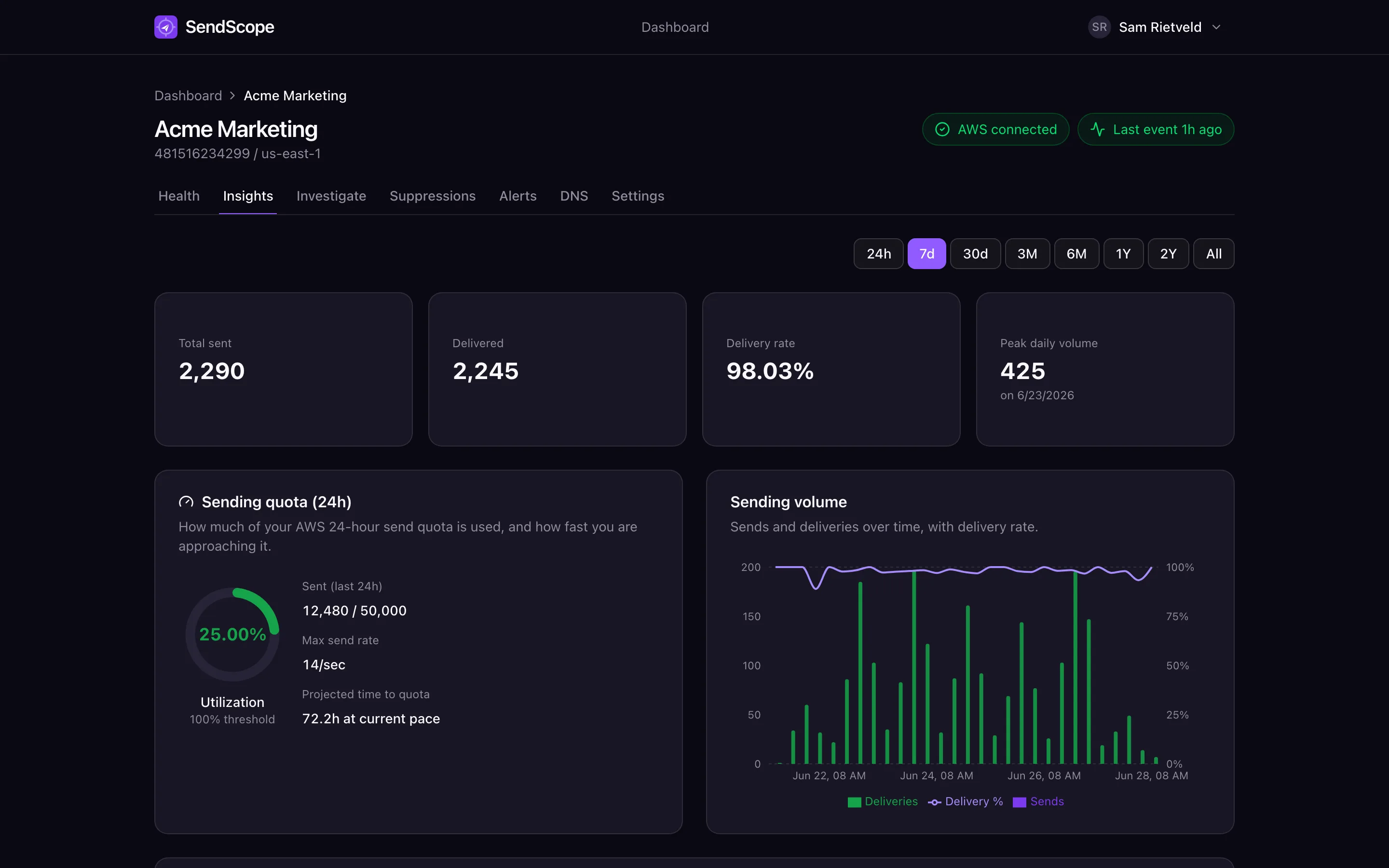
Read your sending the way a deliverability engineer would: a sent → delivered → opened → clicked funnel, open and click rates with device and client breakdowns, top recipient domains, bounce-reason analysis and a send-time heatmap, all computed from your event stream.
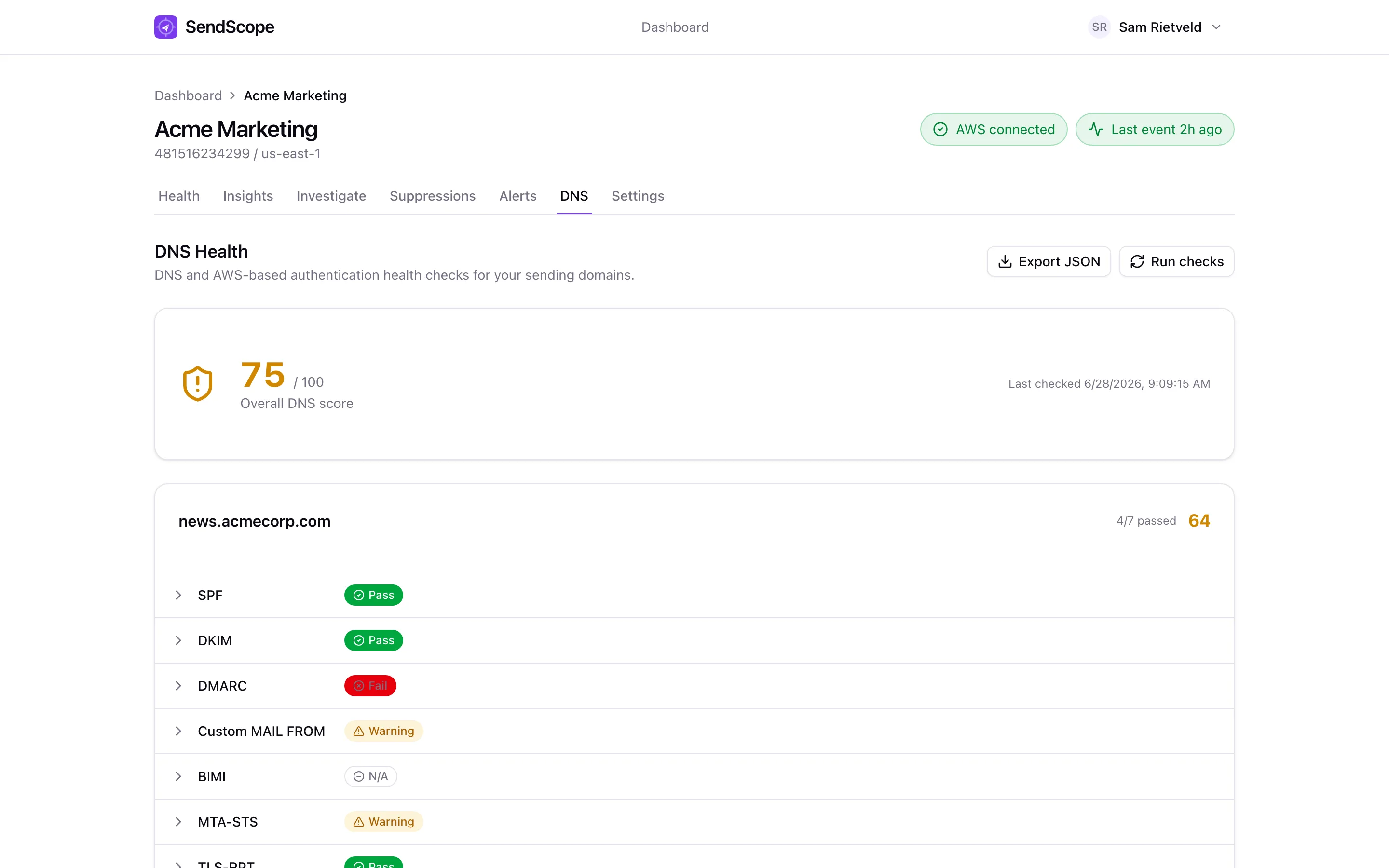
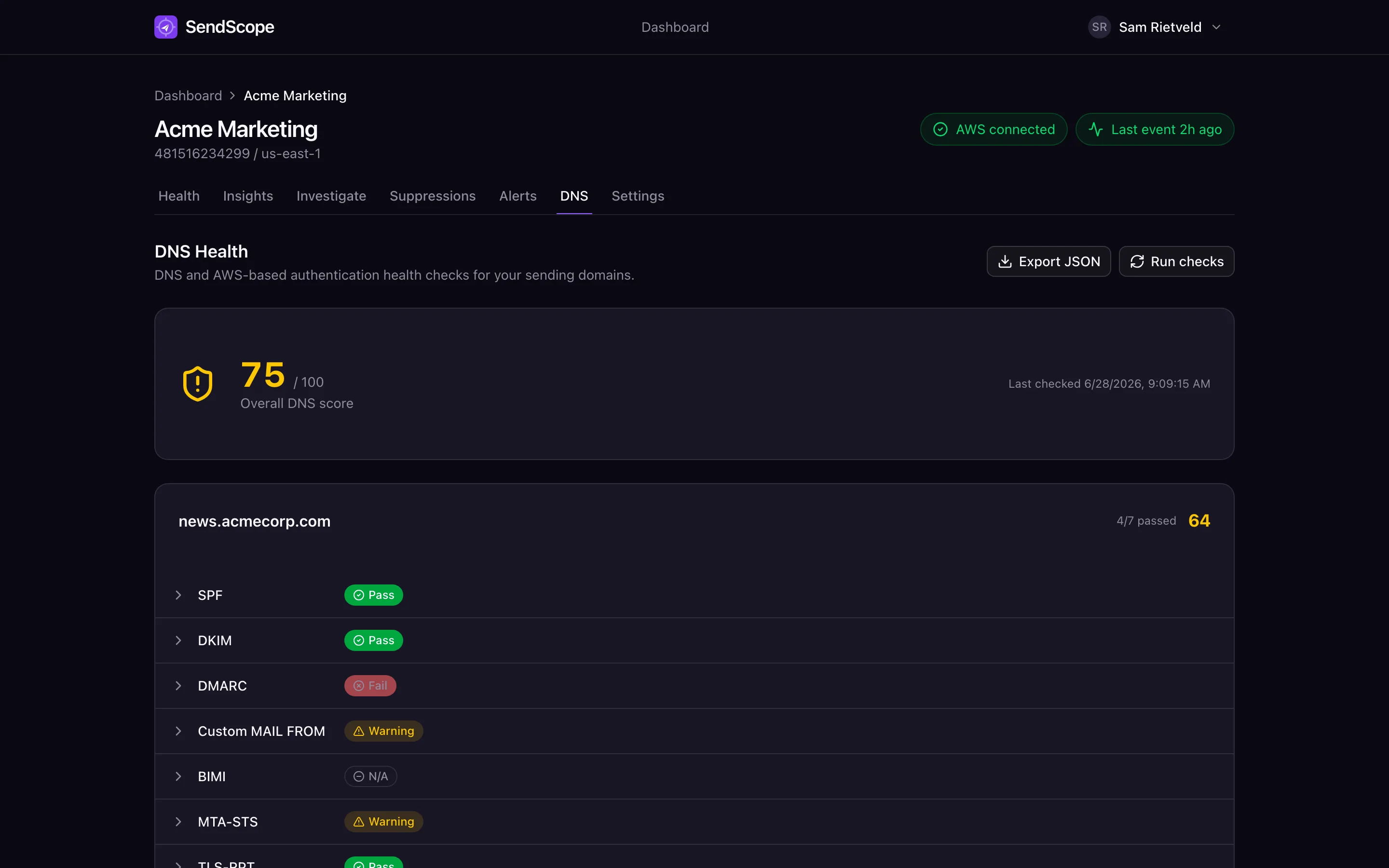
SPF, DKIM, DMARC, custom MAIL FROM, BIMI, MTA-STS, TLS-RPT, reverse DNS and DANE checked per sending domain, scored, and paired with the exact records and fixes to raise it.
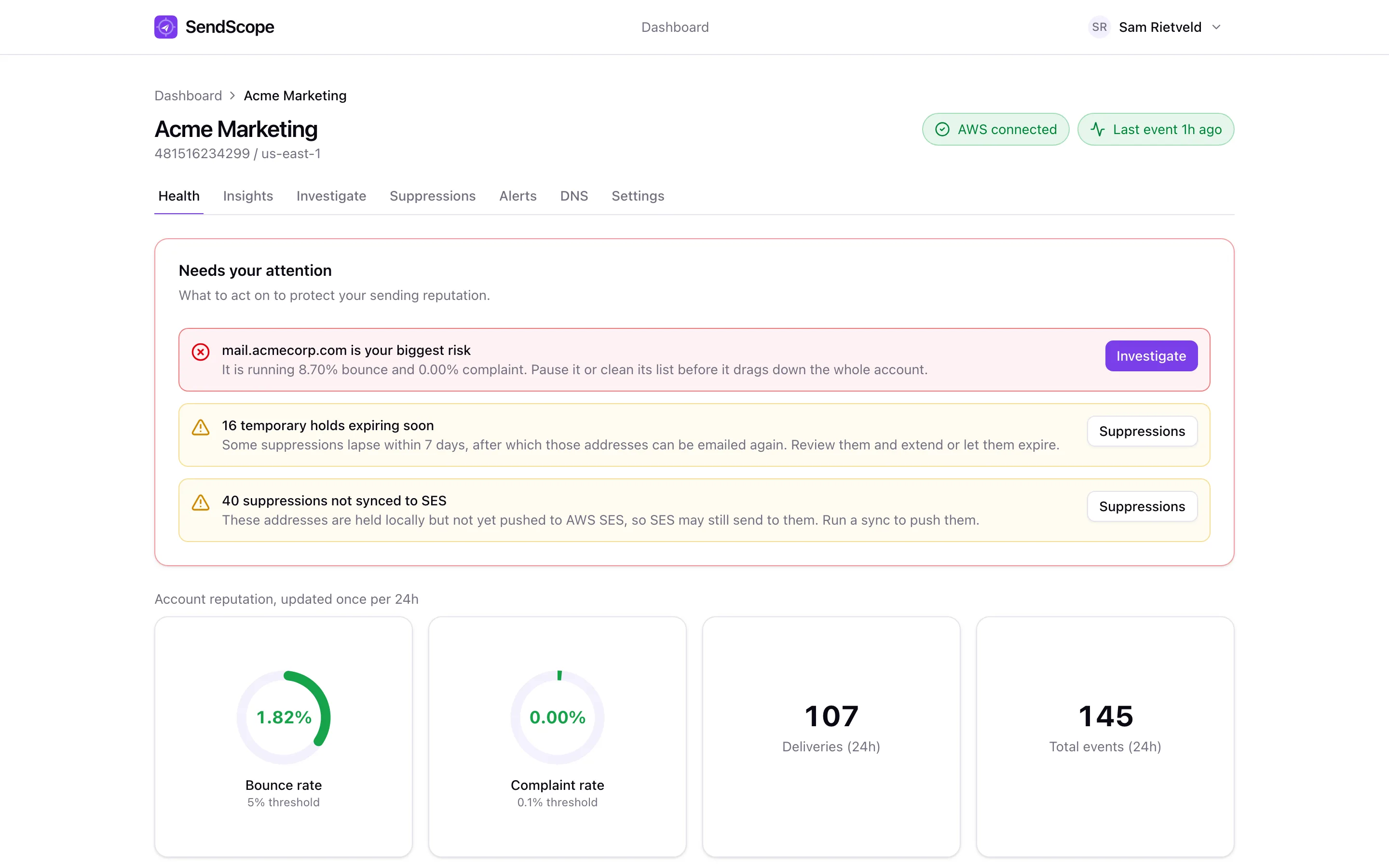
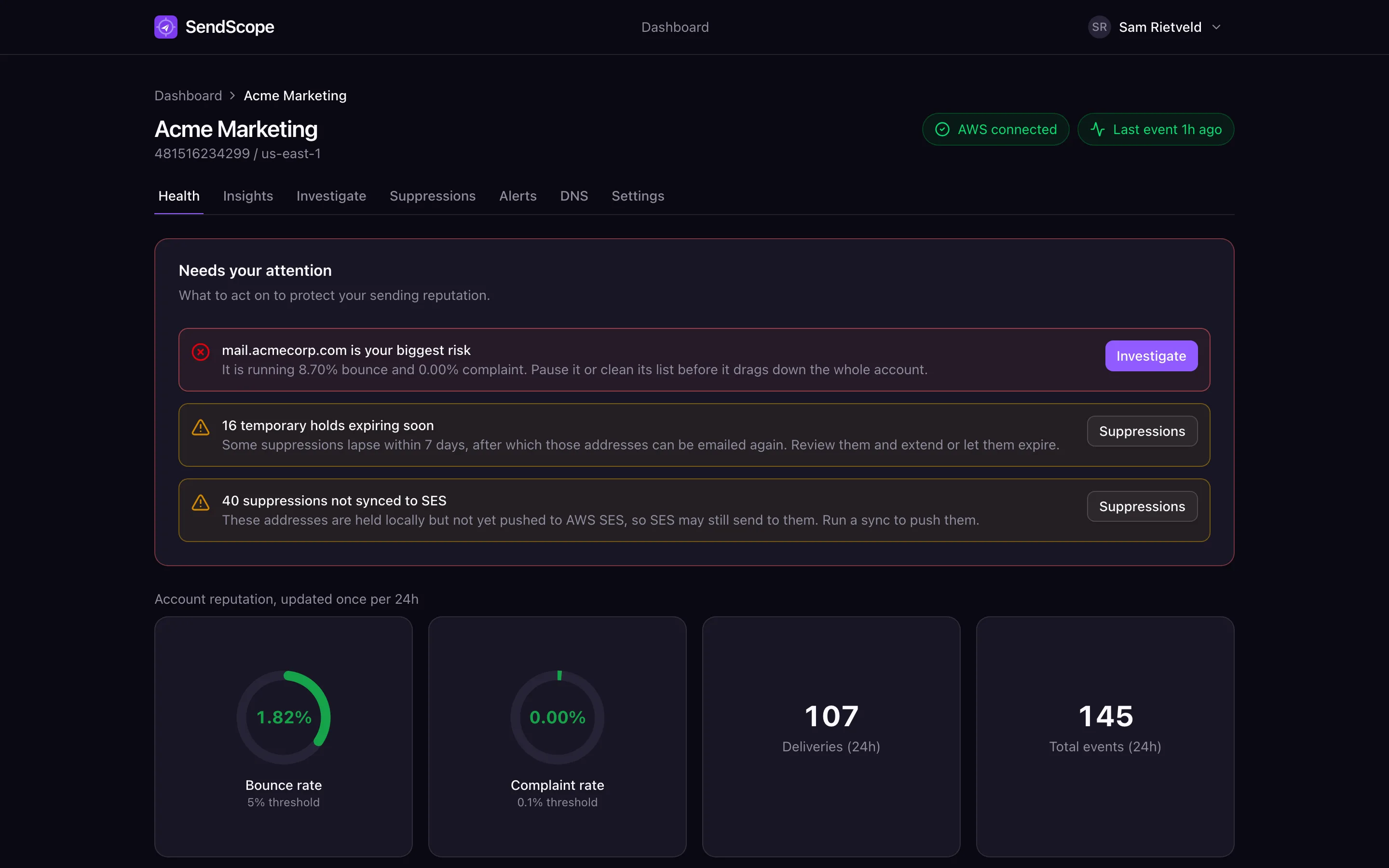
Per account: reputation gauges, the live AWS account status (enforcement, sending, production access and 24h quota), and the most at-risk sending identities, topped by an attention panel that spells out what to fix first.
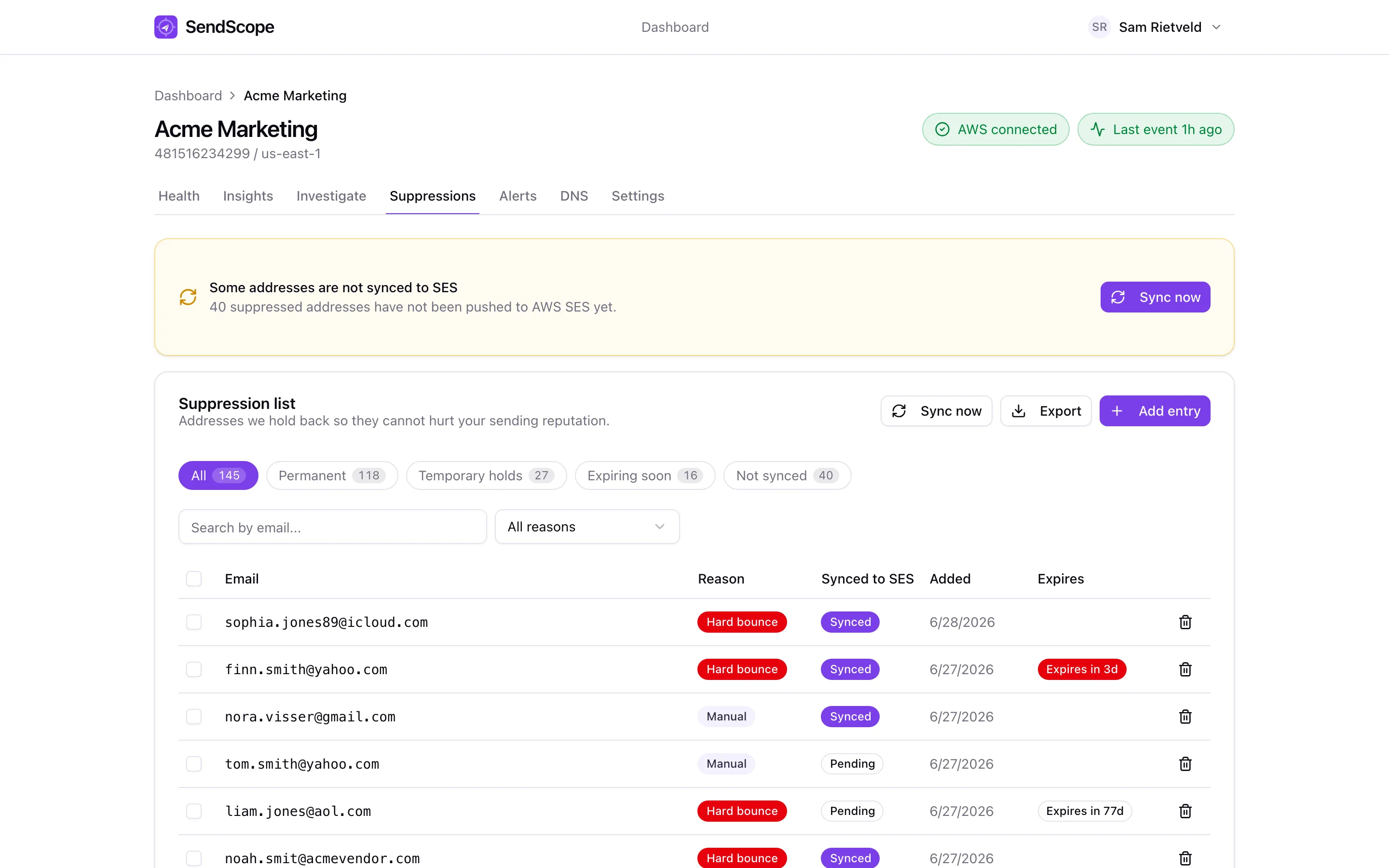
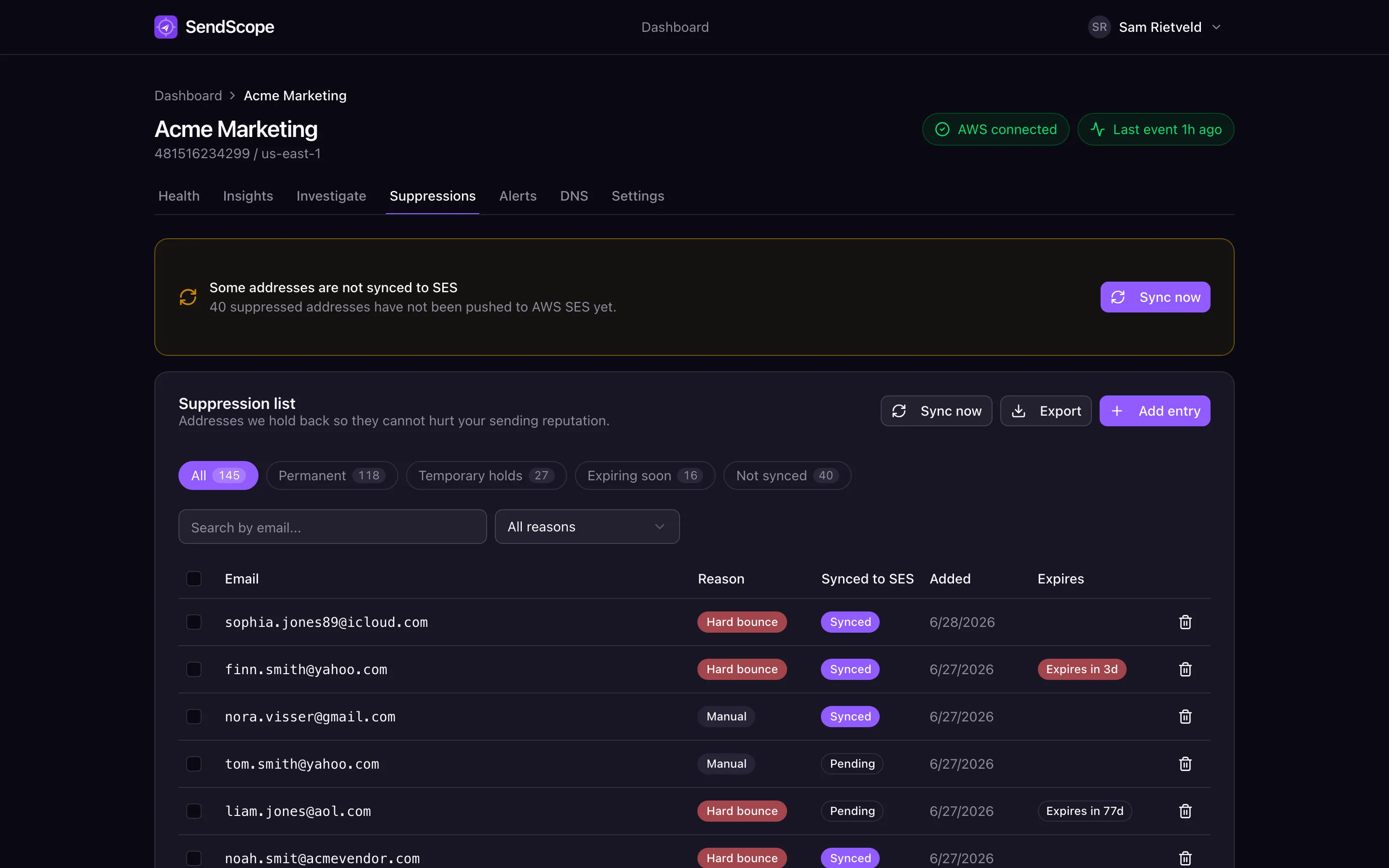
The full suppression list with reason, sync state and expiry, filterable by any of them, exportable, and synced two-way with SES so a stale block never silently drops a real customer.
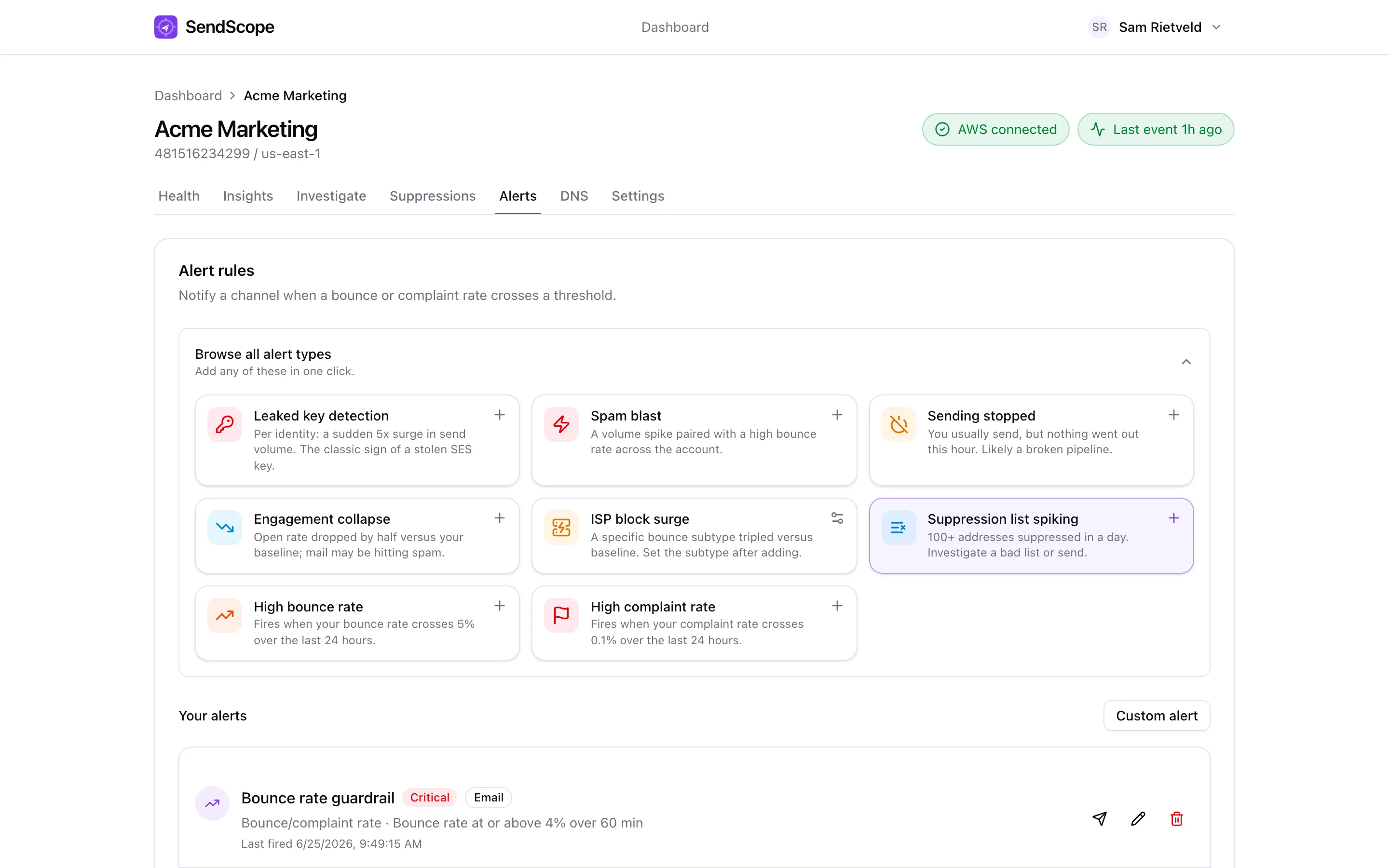
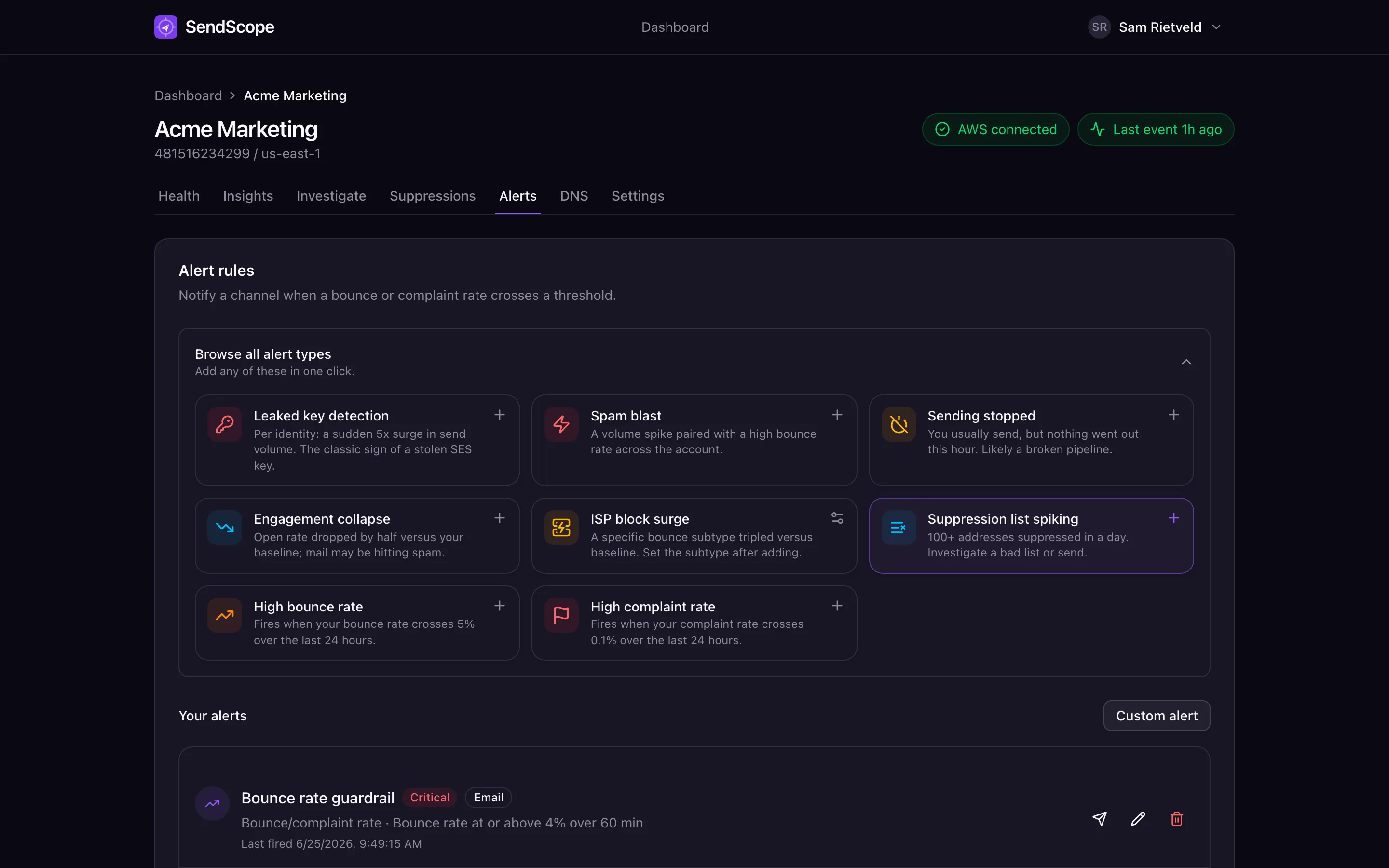
Threshold and anomaly alerts to Slack, email or webhooks from a gallery of presets, daily and weekly digest emails, and a history of everything that has fired, so you hear about a spike from us, not from AWS.
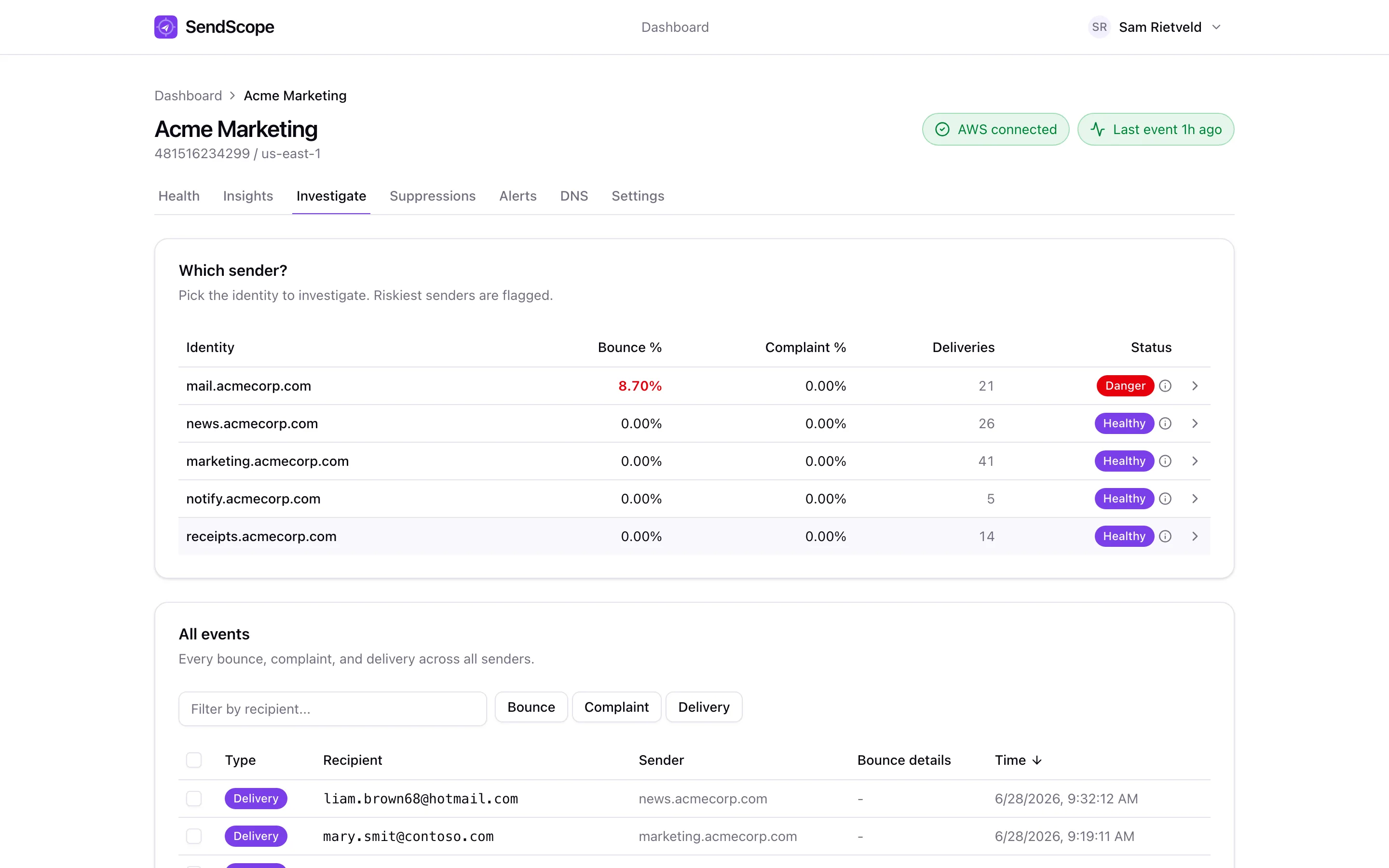
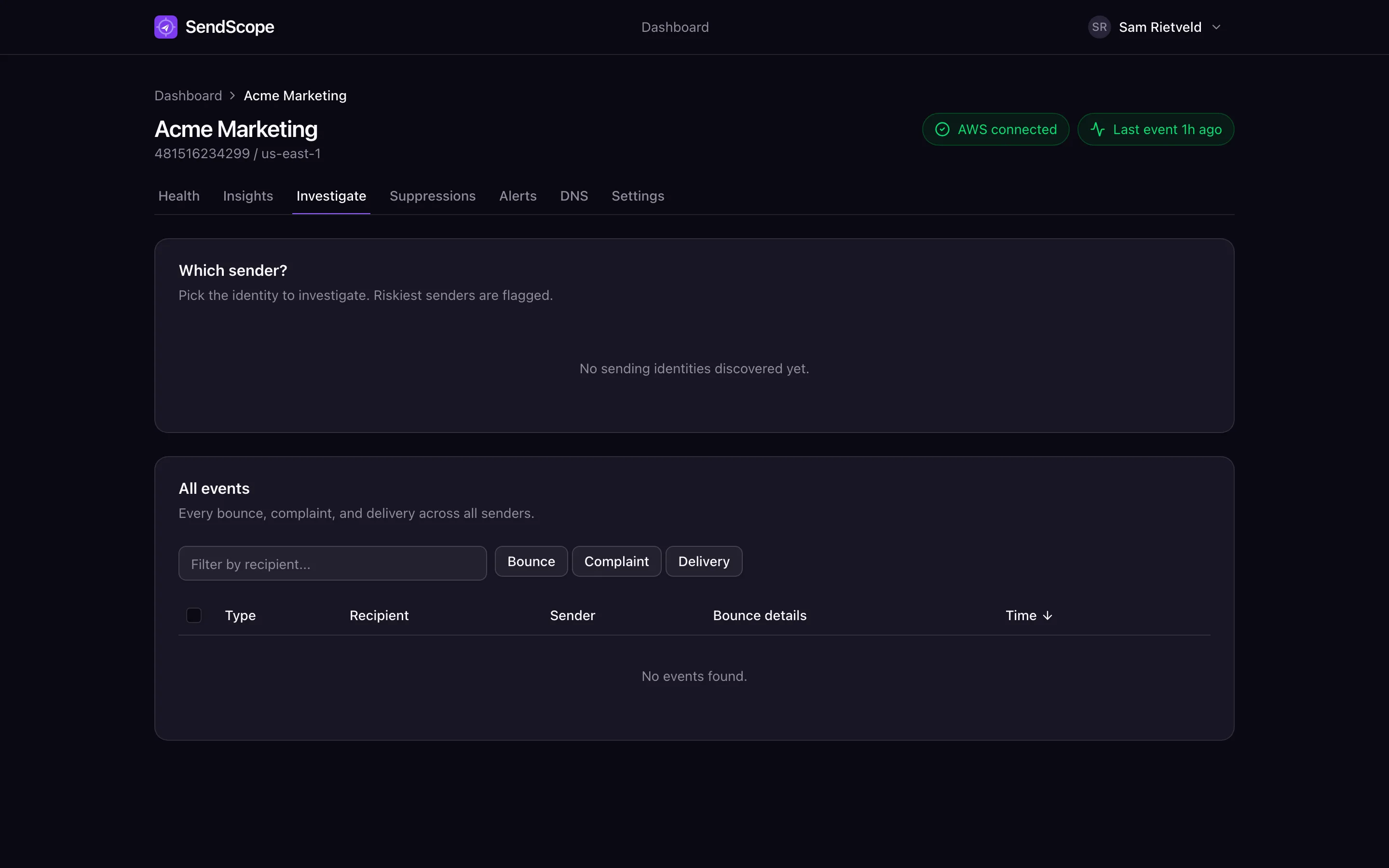
Drill from a rate down to the individual events behind it, filtered by sending identity, recipient and type, to find exactly which messages bounced or drew complaints.
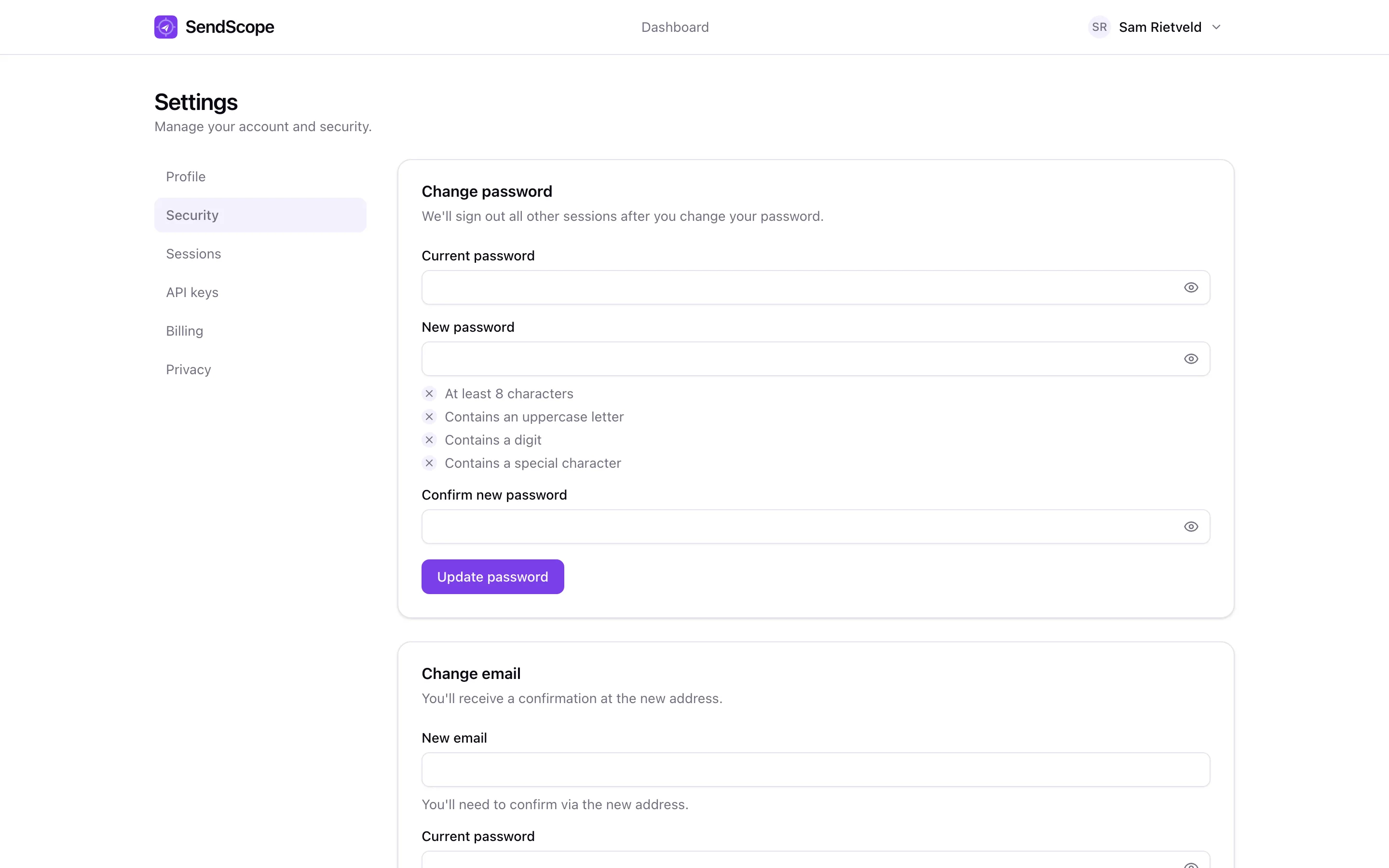
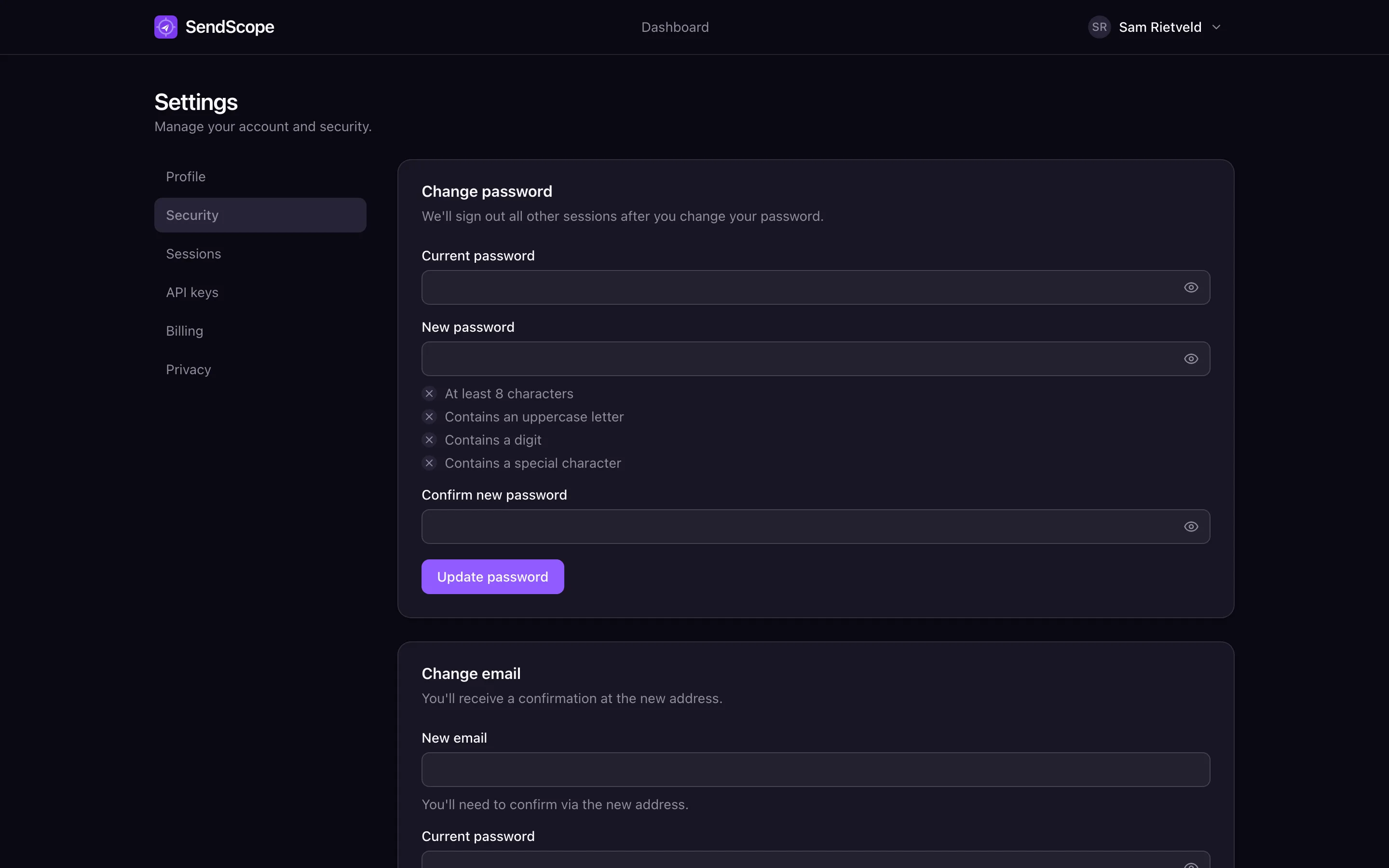
Users manage their own security: password and email changes, TOTP two-factor, passkeys, and linked OAuth accounts, all wired to the API.
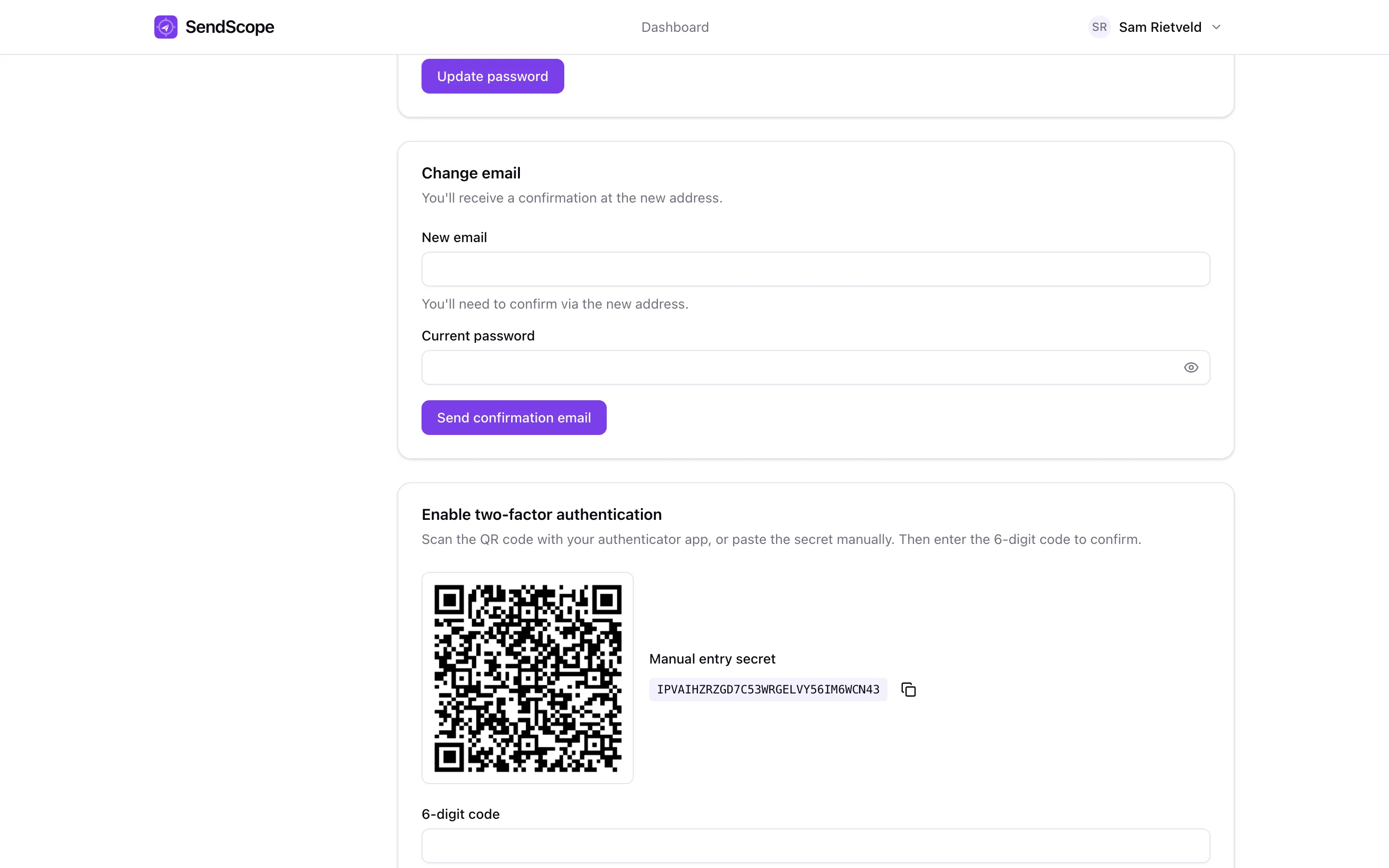
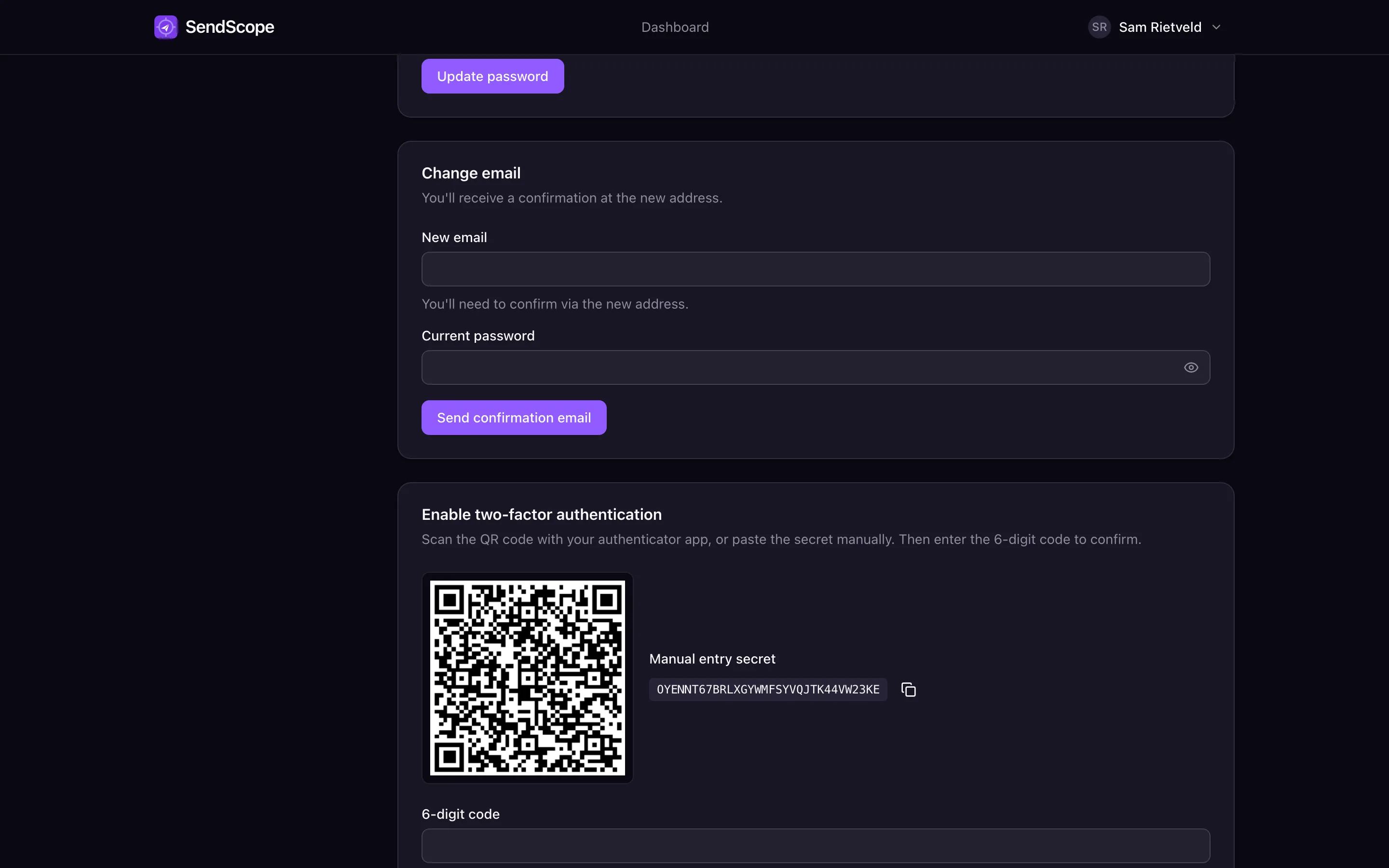
TOTP enrollment with QR code, manual secret and downloadable recovery codes. Disable and regenerate flows are included too.
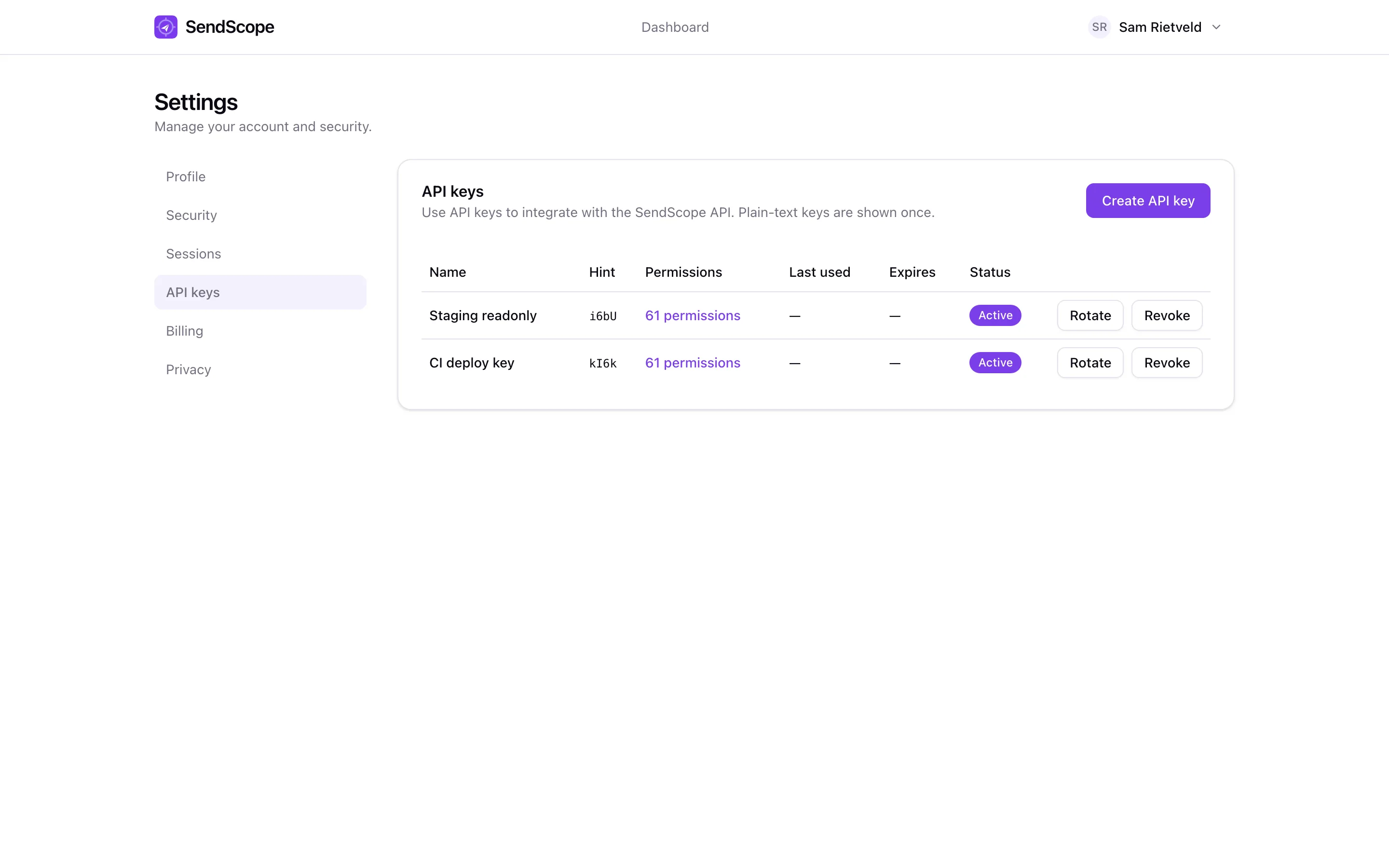
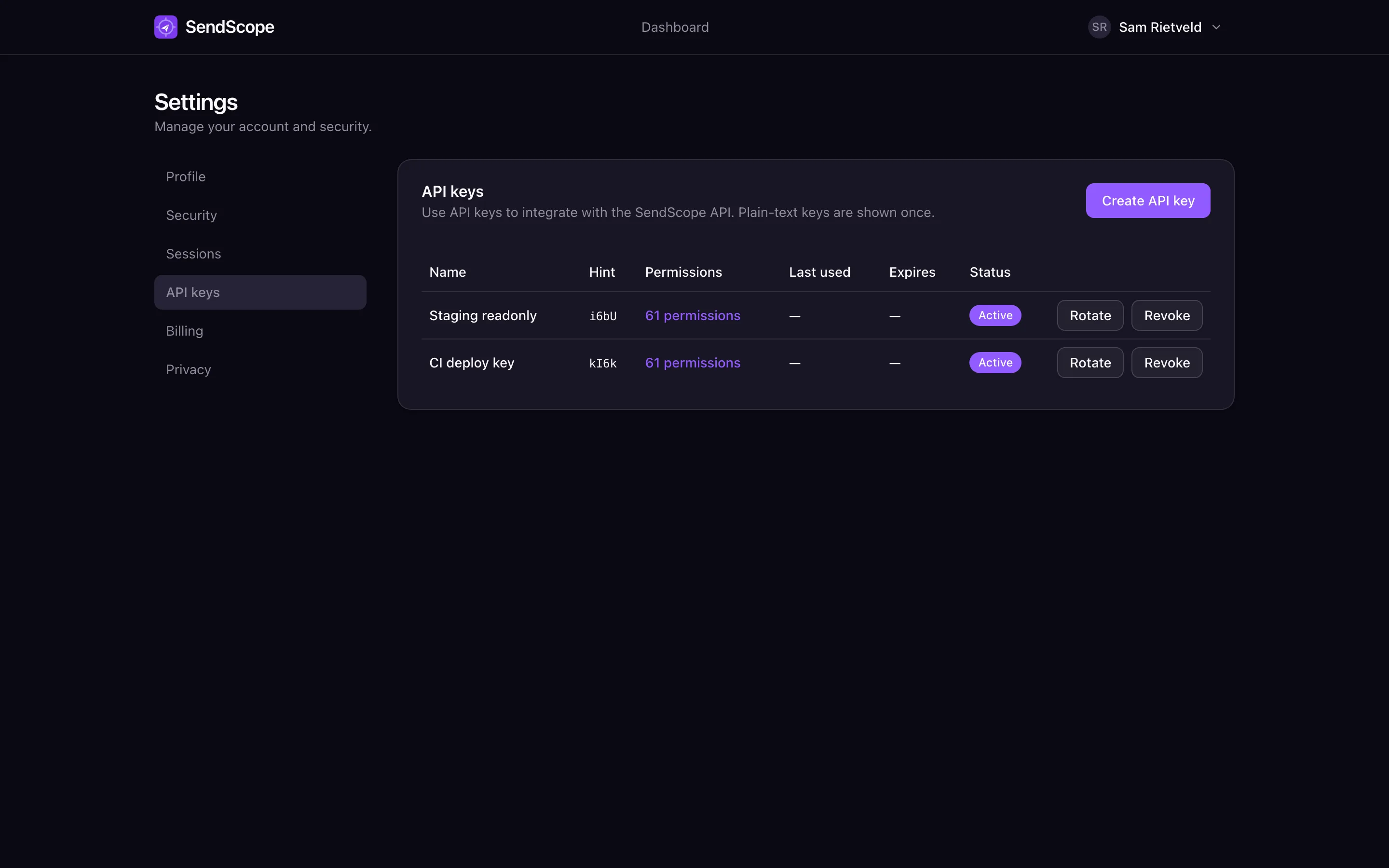
Scoped API keys with per-key permissions, optional expiry, one-time reveal, rotation and last-used tracking.
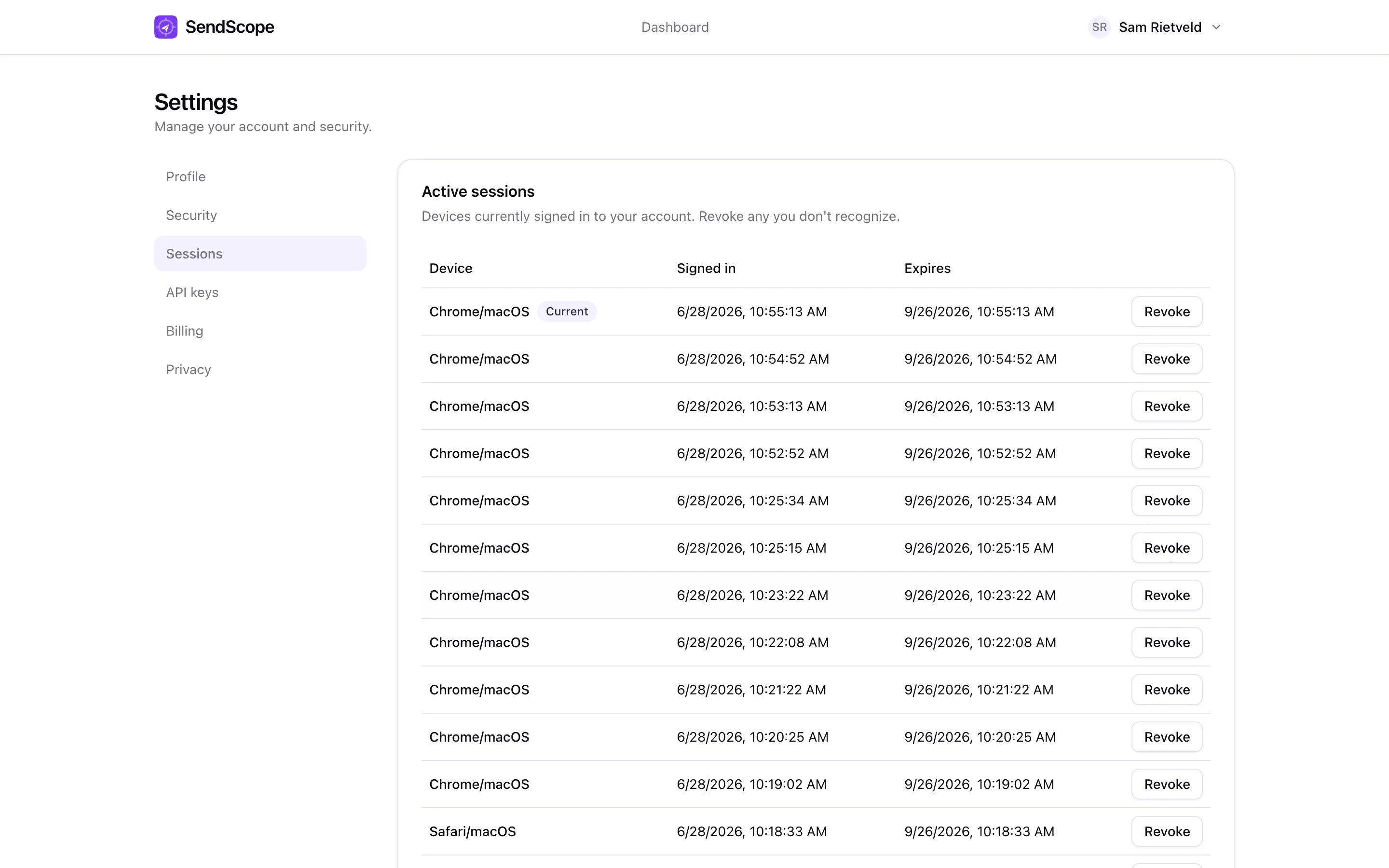
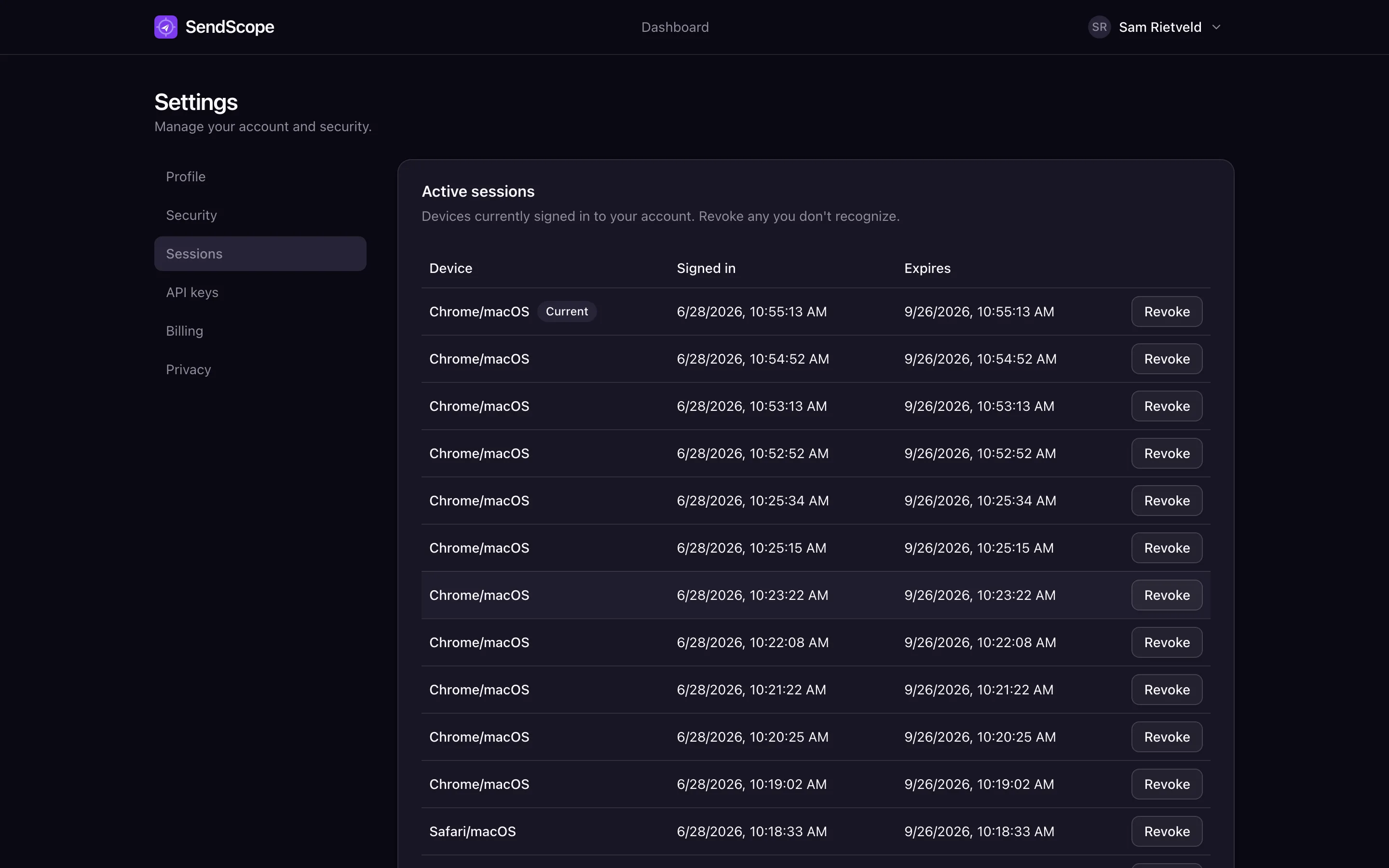
Active sessions per device, with one-click revocation. Refresh tokens rotate in families, so a stolen token revokes the whole chain.
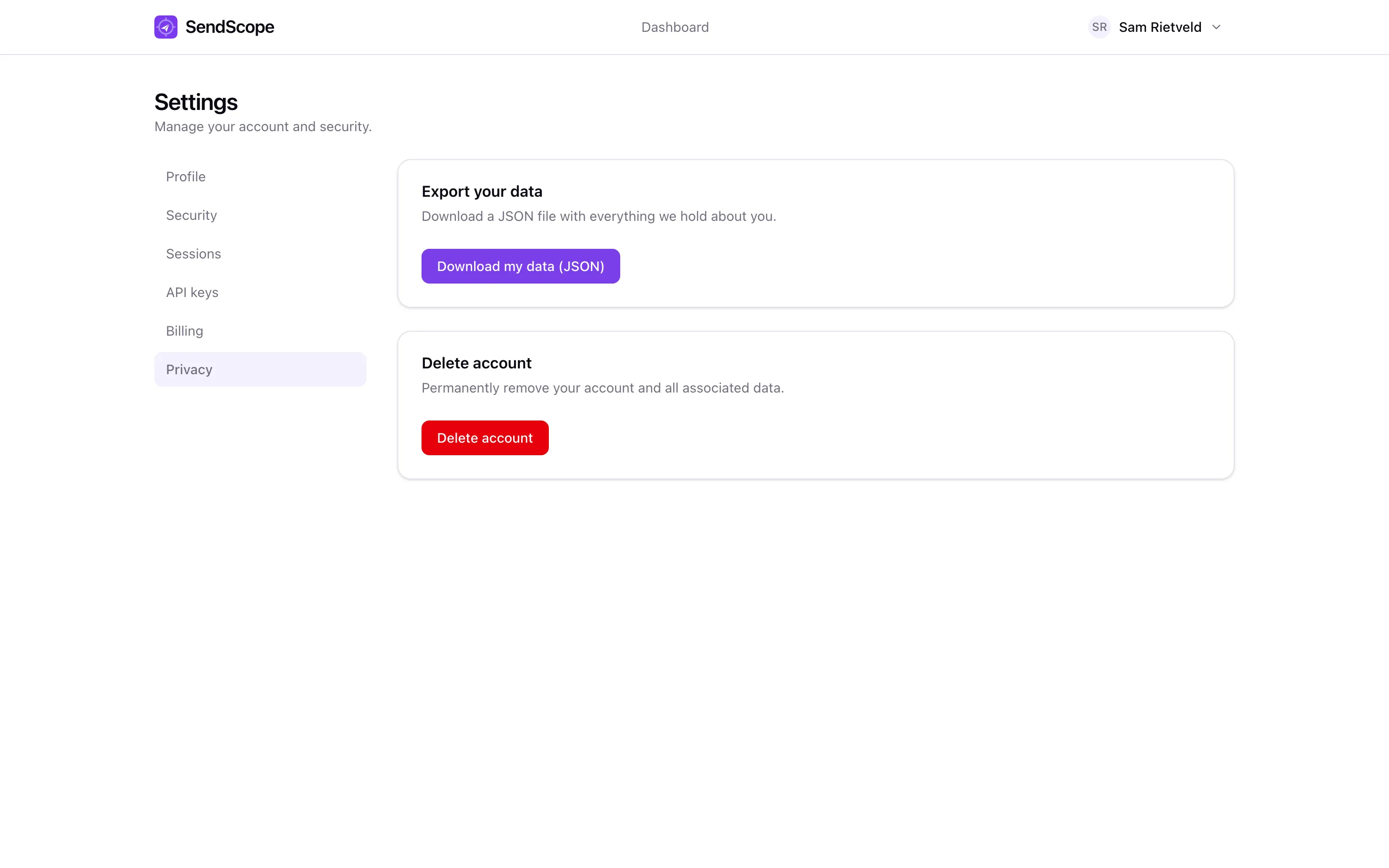
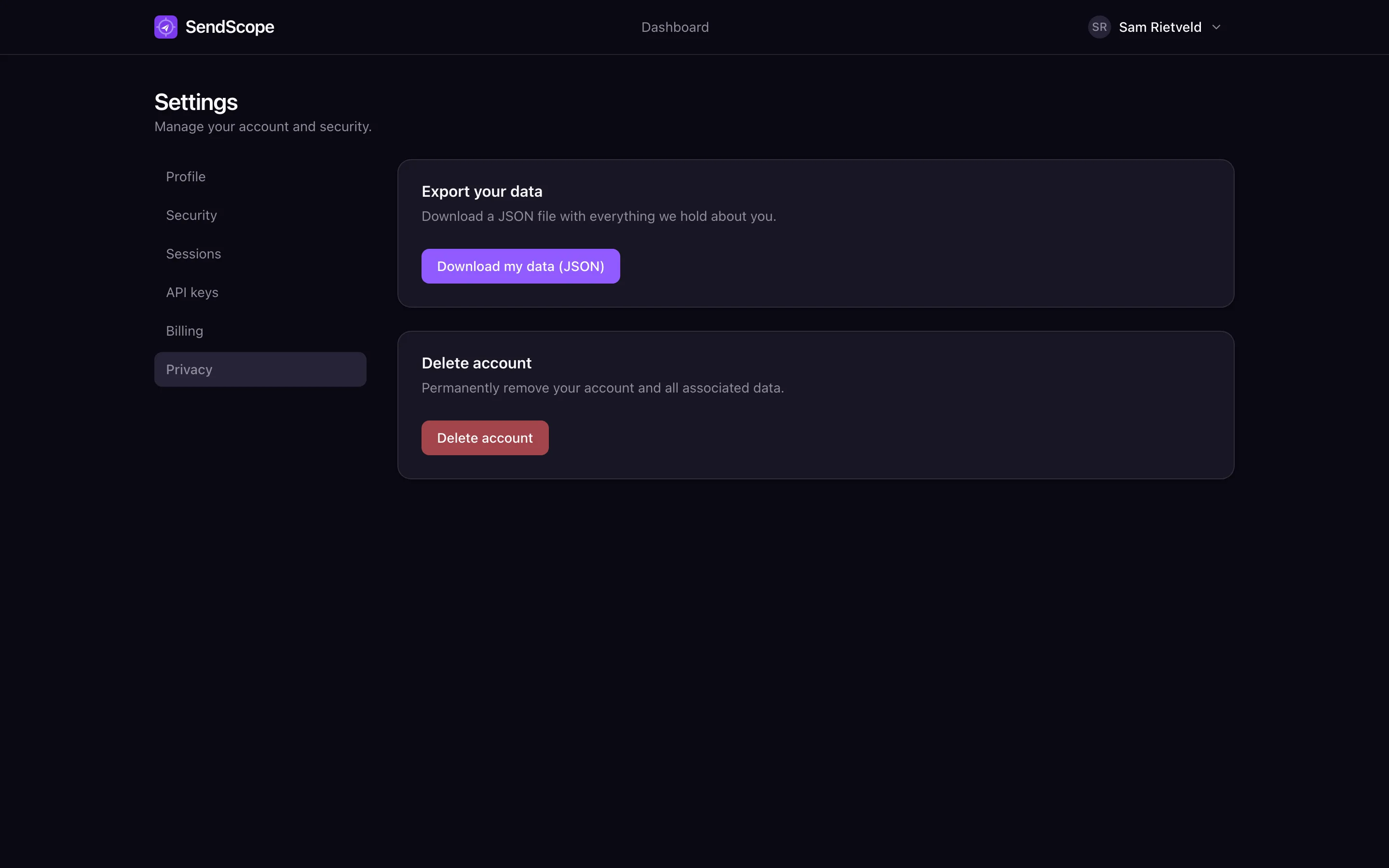
GDPR self-service: users export everything held about them as JSON or delete their account, which anonymizes personal data while keeping referential integrity.
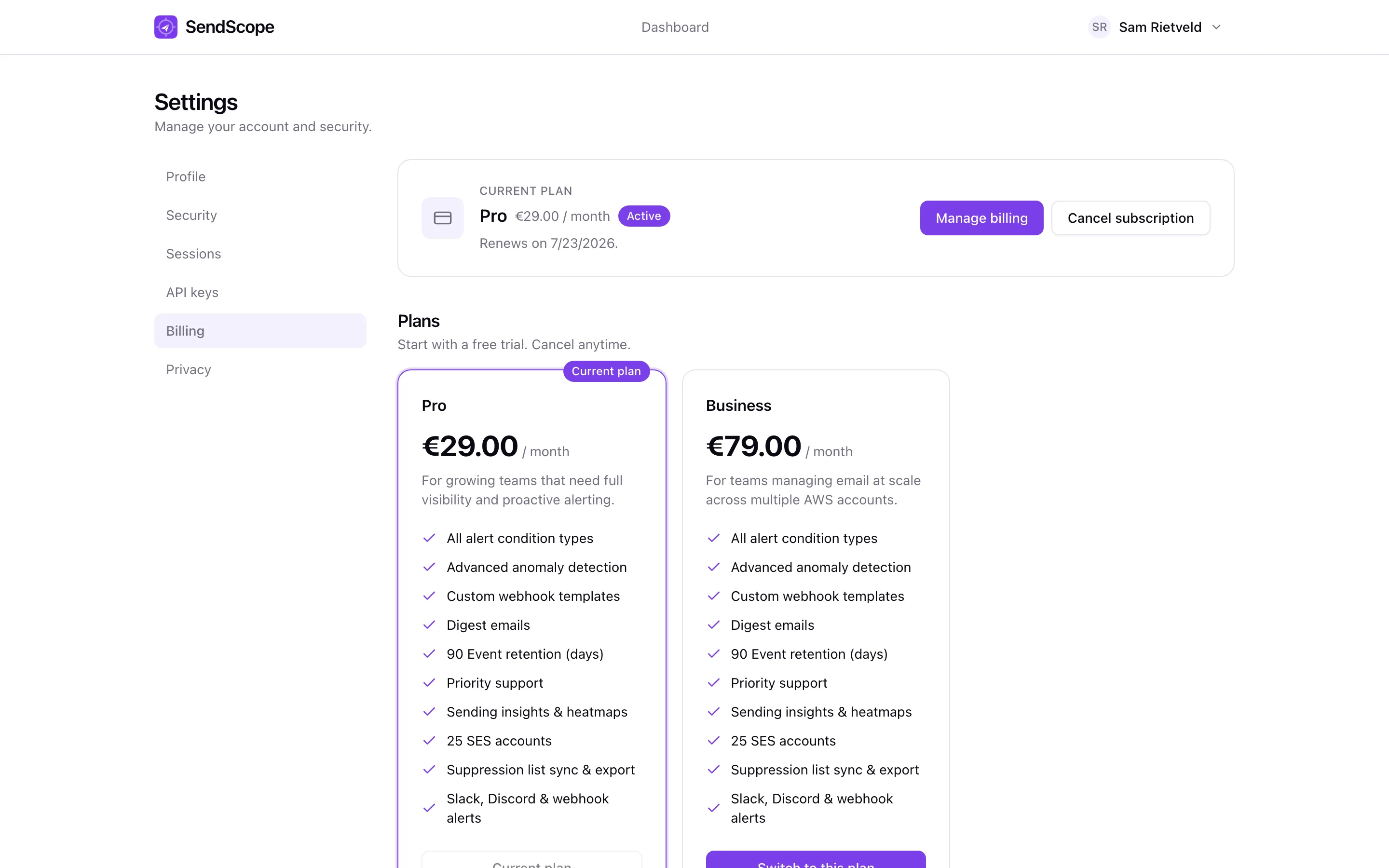
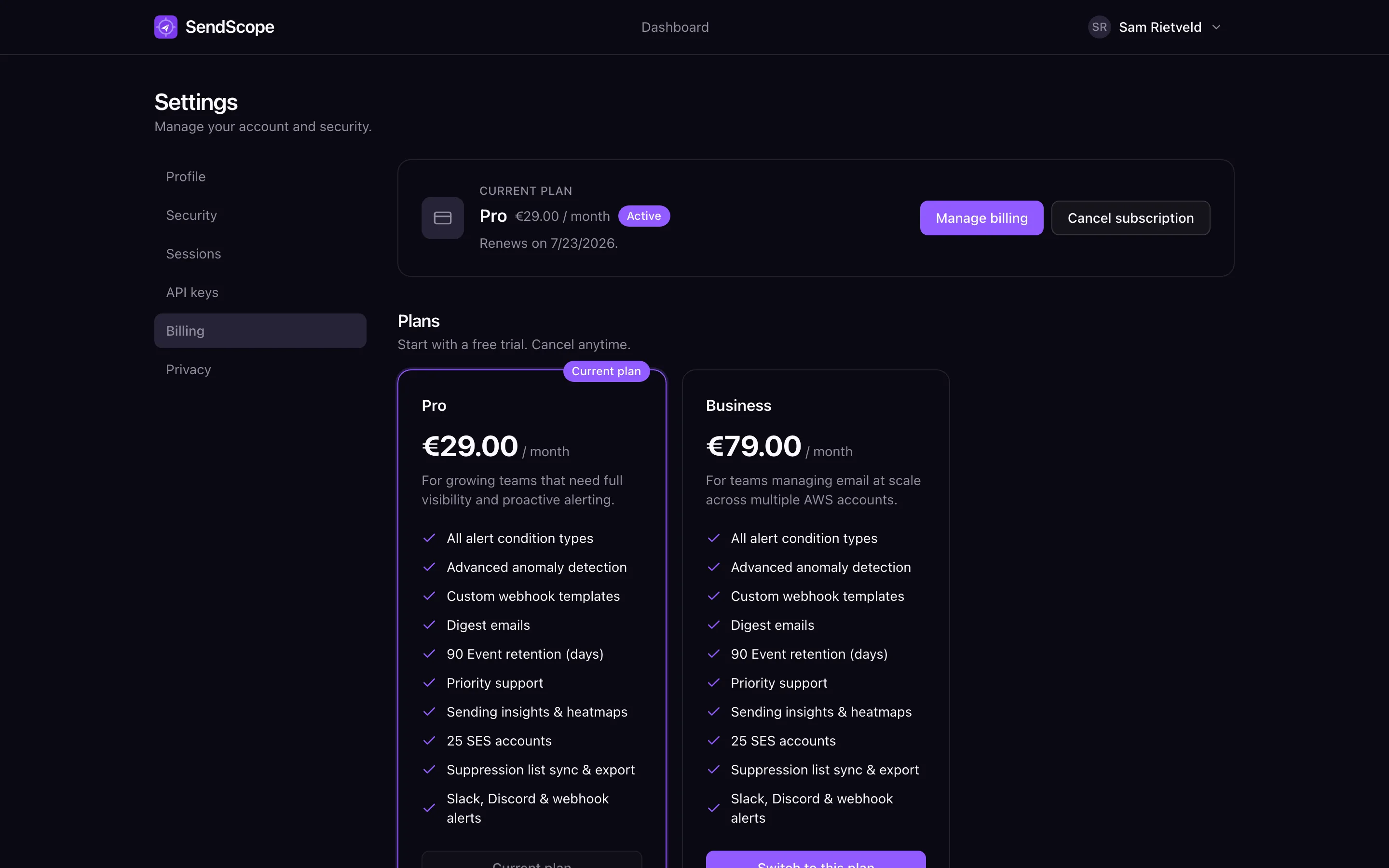
Stripe subscriptions out of the box: plan tiers listed straight from your Stripe catalog, each with a free trial, Checkout and the Customer Portal wired up, and state kept in sync through signed webhooks.
01Reputation monitoring
See your reputation in real time, not after the damage
Bounce rates, complaint rates, delivery rates, engagement metrics: all updated in real time from your SES events. Per-sender and per-domain breakdowns show exactly where problems are forming.
- Real-time bounce, complaint, and delivery rate gauges with AWS threshold lines
- Per-sender identity breakdowns at domain and email level
- Historical trends with configurable time windows (24h to 2 years)
- AWS account health: enforcement status, quota usage, production access
- DKIM, SPF, and DMARC authentication checks with drift history
- Multi-account overview with per-account health badges
02Smart alerting
Get warned before problems become suspensions
Ten intelligent condition types detect issues from every angle, from rate thresholds to authentication drift. Unlike VDM, which has zero built-in alerting, SendScope routes notifications to Slack, Discord, email, or webhooks the moment thresholds are crossed.
- 10 condition types: rate thresholds, reputation danger, quota usage, account health, volume spikes, sending silence, engagement drops, bounce subtype surges, suppression growth, authentication degradation
- Multi-channel delivery: Email, Slack, Discord, Webhooks, Apprise
- Per-identity fan-out with cooldowns and severity levels
- Default safety-net alerts auto-provisioned on every new account
- Test any alert rule before going live
03Suppression management
Never send to a bad address twice
Hard bounces and complaints are automatically suppressed. The bidirectional sync keeps your local list and your AWS SES suppression list in lockstep, so every system agrees on who not to email.
- Auto-suppress hard bounces and complaints as they arrive
- Bidirectional sync with your AWS SES suppression list
- Temporary suppressions with configurable expiry
- Search, filter, bulk delete, and CSV export
- Track sync status per entry with on-demand or scheduled sync
Deliverability funnel (7d)
Sending pattern (last 7d)
04Sending insights
Understand your email, end to end
From the moment an email leaves SES to whether the recipient clicked a link, SendScope tracks the full journey. Heatmaps, domain breakdowns, and anomaly detection turn raw events into actionable intelligence.
- Deliverability funnel: sent, delivered, opened, clicked
- Sending heatmaps by day-of-week and hour-of-day
- Recipient domain breakdown with per-domain rates
- Bounce reason categorization (permanent vs. transient, subtypes)
- Volume anomaly detection and engagement tracking
How it works
Protecting your SES reputation in three steps
Connect your AWS account, configure your alerts, and let SendScope watch your email health around the clock.
Connect your AWS account
Add your IAM credentials and select your region. SendScope auto-configures SNS topics and subscriptions to start receiving events immediately.
Configure your alerts
Set up alert rules for the metrics that matter: bounce rate, complaint rate, quota usage, volume anomalies. Route them to Slack, Discord, email, or webhooks.
Monitor and protect
Watch your reputation in real time, get alerted before problems escalate, and manage your suppression list from one place. Your SES account stays healthy.
Comparison
SendScope vs. VDM
VDM provides dashboards and recommendations at $0.07 per 1,000 emails (with volume discounts at scale). SendScope adds alerting, suppression management, and deeper insights at a flat monthly price.
| Feature | VDM | SendScope |
|---|---|---|
| Rate dashboards | ||
| ISP-level drilldown | By recipient domain | |
| Per-identity metrics | ||
| Configuration recommendations | Advisor | |
| Per-message bounce diagnostics | ||
| Aggregate bounce reason analysis | ||
| Deliverability funnel visualization | ||
| Alerting | 10 condition types | |
| Slack / Discord / Webhook notifications | ||
| DKIM / SPF / DMARC drift alerts | ||
| Suppression list management | Basic SES console | Full UI + sync |
| Sending heatmaps | ||
| Volume anomaly detection | ||
| Scheduled digest reports | ||
| Multi-account from one UI | ||
| Pricing model | From $0.07/1k emails | Flat monthly (from $0) |
05Digest reports
Automated summaries, delivered on your schedule
Daily, weekly, or monthly digest emails summarize your sending health: bounce and complaint rates, volume trends, top recipient domains, recent suppressions, and alert history.
Flexible cadence
Schedule digests daily, weekly, or monthly. Pick the day and time that fits your workflow.
Actionable data
Bounce rates, engagement trends, top domains, and recent suppressions in one email.
Trend detection
Comparative analysis detects bounce and engagement trends vs. the prior period, so you spot regressions early.
Pricing
Simple pricing that scales with you
Start free with one SES account. Upgrade when you need more accounts, advanced alerts, and deeper insights. No per-email fees, ever.
Starter
Free
For side projects and small senders getting started with SES monitoring.
- 1 SES account
- Real-time dashboard
- Default safety-net alerts
- Email notifications
- API access
Pro
€29/mo
For growing teams that need full visibility and proactive alerting.
- Up to 5 SES accounts
- Up to 10 recipients per alert and digest
- All 10 alert condition types
- Slack, Discord and webhook alerts
- DKIM, SPF and DMARC monitoring
- Digest emails (daily, weekly, monthly)
- Suppression list sync and export
- Sending insights and heatmaps
Business
€79/mo
For teams managing email at scale across multiple AWS accounts.
- Unlimited SES accounts
- Everything in Pro
- Priority email support
- Custom webhook templates
- Advanced anomaly detection
- Team member access
All paid plans include a 7-day free trial. No credit card required to start. Need a custom plan? Contact us.
FAQ
Common questions
Everything you need to know about SendScope. Something else on your mind?Get in touch.
How does SendScope connect to my AWS SES account?
You provide IAM credentials with read-only SES and CloudWatch access, and SendScope sets up SNS topics to receive bounce, complaint, delivery, open, and click events. A guided setup wizard walks you through the entire process, or you can use the auto-configure feature that creates the SNS topics and subscriptions for you in one click.
What happens if SendScope goes down?
Your email sending is completely unaffected. SendScope is a monitoring layer, not a sending proxy. It reads events and metrics from AWS; it never sits in the delivery path. If SendScope is temporarily unavailable, events queue in SNS and are processed when service resumes.
How quickly does SendScope detect issues?
Event-based alerts (rate thresholds, volume spikes, sending silence, engagement drops) evaluate every 5 minutes. AWS-level checks (reputation danger, quota usage, account health) evaluate every 15 minutes. You can configure per-rule cooldowns to avoid alert fatigue.
What alert channels are supported?
Email, Slack (via webhook), Discord (via webhook), generic HTTP webhooks with customizable payloads, and Apprise for unified notifications. Each alert rule can target a different channel, so your ops team gets Slack pings while your email team gets email summaries.
Is my AWS data secure?
AWS credentials are encrypted at rest using AES-256 via ASP.NET Data Protection. Credentials are never returned to the client after initial setup. All webhook URLs are validated against SSRF (private IPs, loopback, metadata endpoints are blocked). The platform includes a hash-chained audit trail of all security-relevant actions.
Is SendScope GDPR compliant and where is my data stored?
Yes. SendScope is GDPR compliant and all data is stored on infrastructure hosted in the European Union. You can export your personal data and delete your account at any time, which removes your accounts, events, suppression entries, and alert history. AWS credentials are encrypted at rest, and all security-relevant actions are recorded in a tamper-evident audit trail.
Can I monitor multiple AWS accounts and regions?
Yes. Each SES account you connect can be in a different AWS region. The Pro plan supports up to 5 accounts, and the Business plan supports unlimited accounts. Each account gets its own dashboard, alerts, and suppression list.
How is this different from AWS VDM or CloudWatch?
VDM provides dashboards with rate graphs, ISP drilldowns, per-message diagnostics, and configuration recommendations via its Advisor. It costs $0.07 per 1,000 emails (with volume discounts to $0.02 at 100M+ emails/month). However, it has no built-in alerting, no suppression management, and no aggregate analytics like deliverability funnels or sending heatmaps. CloudWatch provides SES metrics (sends, deliveries, bounces, complaints, opens, clicks) but you need to build your own alarms and notification pipelines. SendScope adds 10 alert condition types with Slack/Discord/webhook delivery, bidirectional suppression sync, deliverability funnels, DKIM/SPF/DMARC authentication monitoring, anomaly detection, and scheduled digests, all at a flat monthly price with no per-email surcharge.
Do you offer a free trial?
Yes. The Starter plan is free and includes one SES account with a real-time dashboard and default safety-net alerts. Paid plans include a 7-day free trial so you can evaluate the full feature set before committing.
What does the suppression sync do?
SendScope automatically adds hard-bounced and complained addresses to your local suppression list. It then syncs these entries to your AWS SES account-level suppression list, and imports any entries that exist on the AWS side. This bidirectional sync runs every 15 minutes automatically, or you can trigger it on demand.
Can I export my data?
Yes. Suppression lists can be exported to CSV. Event data is available through the API. SendScope also supports full personal data export and account deletion for GDPR compliance.
Start monitoring your SES reputation today
Connect your first AWS SES account in under 5 minutes. See your bounce and complaint rates in real time, get alerted before thresholds become suspensions, and finally have the visibility your email infrastructure deserves.